
You are currently browsing the category archive for the ‘News’ category.

The Classic Film Show isn’t only about Hollywood. It’s probably fair to say that we do not watch as many British films as we should so it’s great to see three obscure Ealing Studios titles being resurrected on DVD. Of the four I have only seen Pink String and Sealing Wax which I remember being enjoyably melodramatic and set in a very Victorian England.
I have a particular fondness for Ealing movies. Partly because that is where I come from – indeed the studios are ten minutes from here – but have always loved films such as The Lavender Hill Mob, The Man in the White Suit and especially The Ladykillers.
Here is some info on the movies from the Optimum website:

San Demetrio, London follows the compelling true story of a crew of British seaman who in 1940 were forced to abandon ship after being torpedoed by German forces. Having been set adrift in their lifeboat for twenty four hours the crew of the San Demetrio must come to a fateful decision: to either withstand the harsh, deadly and fatal conditions of an unrelenting November Atlantic or risk re-boarding the hazardous, flaming decks of the San Demetrio with it’s highly explosive cargo of 12,000 tonnes of aviation fuel in an attempt to sail it back home to safety of the British coast.
Directed by Charles Frend (The Cruel Sea, Scott Of The Antarctic and TV shows The Man In A Suitcase and Dangerman) and written by Robert Hamer (School For Scoundrels, Kind Hearts And Coronets), San Demetrio, London is brimming with dramatic tension and is a gripping, inspiring testament to the rarely acknowledged bravery of the merchant navy during the second world war.

From the director of Scott Of The Antarctic, The Cruel Sea and San Demetrio, London (Charles Frend) comes the whimsical, heart warming comedy Johnny Frenchman.
Veteran theatre comedian Tom Walls plays the Harbour Master in a small Cornish fishing village whose constant run ins with a French fish poacher, played by Francoise Rosay, often leave him outwitted and sworn to revenge. To make matters worse the French poacher’s son, played by Paul Dupuis, is starting to make romantic advances towards the harbour master’s young, impressionable, beautiful blonde daughter, played by Patricia Roc. But as the threat of Nazi Germany rears its ugly head, common adversaries suddenly realise that the future of the village depends on them putting their differences aside and joining forces to fight the good fight.
Johnny Frenchman follows in the comedic traditions of the ever reliable Ealing Studios and includes a cast that features genuine Cornish villagers and actual members of The French Resistance.

Pink String and Sealing Wax (1945)
In 1890’s Brighton the young son of a puritanical chemist longs to escape the repressive environment of his family life and the overbearing restraints of his cruel, pious father. Eventually finding refuge in a local tavern he his immediately attracted to the sordid glamour of the drinking classes and the gritty world that they inhabit. He also finds himself becoming infatuated with the tavern’s landlady, which will inadvertently lead to him being drawn into a plot to kill her abusive husband.
Directed by Robert Hamer (Kind Hearts And Coronets, San Demetrio, London and School For Scoundrels) , Pink String And Sealing Wax stars Googie Withers (The Lady Vanishes), Mervyn Johns (Dead Of Night) and Gordon Jackson (Whisky Galore, The Quatermass Experiment) in a film that cleverly entwines the dynamics of a thriller with biting social commentary and a multi-layered plot structure that contrasts the parallels of the British class system.
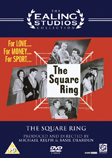
Richly comic, tensely dramatic, romantically moving – THE SQUARE RING looks beyond the stadium lights of 1950s boxing and into the lives of the men who fight for fame and fortune – and the women who fight to hold them.
Featuring an enviable British cast including Carry On stalwerts Bill Owen and Sid James (Carry On Sargeant, Carry on Nurse), and a touching performance from a young Joan Collins (Dynasty, Fear in the Night), THE SQUARE RING is an Ealing classic not to be missed.
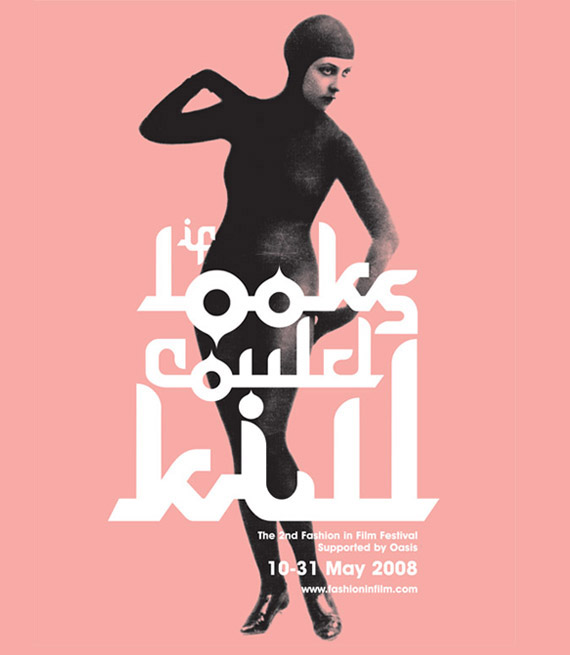
The 2nd Fashion in Film Festival kicks off tomorrow in London, spreading itself across the BFI Southbank, ICA, Ciné Lumière and Tate Modern.
The scope is large and imaginative. Below are some highlights for me (from the online catalogue), though there is a lot of more recent titles which also look very interesting including a remake of The Red Shoes from South Korea.
Note in particular the illustrated lecture by the brilliant academic writer Tom Gunning and the UK Premiere of a Czech silent, The Kidnapping of Fux Banker (1923). It also includes one of my particular favourites, Leave Her to Heaven (1945) starring the exquisite Gene Tierney. It’s also great to see silents make such a prominent appearance.
|
|||||||||||||||||||


 |
Silent Film’s Thieves, Jewel Robberies and Cases of the Lost Glove Introduced by Christel Tsilibaris. Sunday 18 May, 17.00, Ciné lumière A Man With White Gloves (L’homme aux gants blancs) The Gentleman Thief (aka Max Leads Them a Novel Chase ; Le voleur mondain) Nick Winter and the Case of the Famous Hotel (Nick Winter et l’affaire du Célébric Hôtel ) The Pearl (La Perle) |
|||
 |
The Kidnapping of Fux Banker (Únos bankére Fuxe) Czech Republic 1923. Dir Karl Anton. With Anny Ondra, Karel Lamac. 75 min. 35mm. UK PREMIERE New musical accompaniment by DJ Charles Kriel and “funny face”. Introduced by Marketa Uhlirova. Sunday 25 May, 18.20, BFI Southbank NFT1 |
|||
 |
The Rat UK 1925. Dir Graham Cutts. With Ivor Novello, Isabel Jeans. 80min. 35mm. Saturday 24 May 17:45, BFI Southbank NFT1 |
|||
 |
Asphalt (Der Polizeiwachtmeister und die Diamantenelse) Germany 1929. Dir Joe May. With Betty Amann, Gustav Fröhlich. 94 min. 35mm. With live piano accompaniment. Sunday 25 May, 15.30, BFI Southbank NFT1 |
|||
 |
Desire OASIS Gala screening USA 1936. Dir Frank Borzage. With Marlene Dietrich, Gary Cooper. 89 min. 35mm. Saturday 17 May, 20:30, Ciné lumière |
|||
 |
The Lodger : A Story of the London Fog UK 1927. Dir Alfred Hitchcock. With Ivor Novello, June. 98 min. 35mm. Introduced by Alice Rawsthorn. With live musical accompaniment. Tuesday 13 May, 18.30, BFI Southbank NFT1 |
|||
 |
Leave Her to Heaven USA 1945. Dir John M. Stahl. With Gene Tierney. 105 min. 35mm. Monday 19 May, 18.20, BFI Southbank NFT2 |
|||

Some very exciting news. I just received a message from Criterion announcing that they will be releasing titles in Blu-Ray, and that we will see them on shelves in October.
Criterion have revealed that, ‘These new editions will feature glorious high-definition picture and sound, all the supplemental content of the DVD releases, and they will be priced to match our standard-def editions.’
And here are their first titles:
The Third Man
Bottle Rocket
Chungking Express
The Man Who Fell to Earth
The Last Emperor
El Norte
The 400 Blows
Gimme Shelter
The Complete Monterey Pop
Contempt
Walkabout
For All Mankind
The Wages of Fear
It will be interesting to discover how far these Blu-Ray editions from Criterion, who are of course known for their high standards in image quality, enhance the viewing experience of films of varying ages. I am optimistic that the result may very well be worth the wait.
There is currently no information on their site here, but I will keep you posted on any further developments.
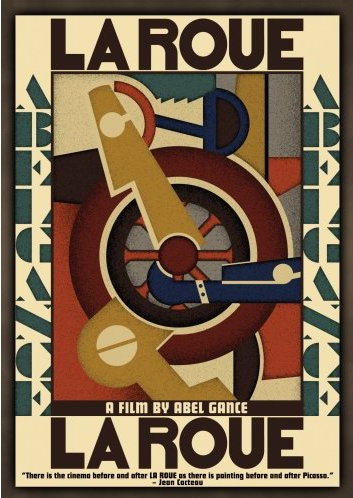
A very exciting 2-disc DVD has just been released: La Roue (1927), a monumental silent directed by Abel Gance. I saw this film on the big screen and at that time it ran at four hours, but this new restoration seems to come in even longer at four and a half.
It revolves around a steam train engineer and the infant girl he saves from a train wreck, evolving into a complex and delicate drama. While containing some devastating and kinetic imagery, particularly around steam engines, it ultimately is one of the most memorable silent film experiences out there. Finally I get to see it again.
Directed by Abel Gance whose Napoleon (1927) is legendary, this is highly recommended. It is published by Flicker Alley, who has emerged as a great new distributor of rare silents on DVD. Check it out at their website.
Today I visited the Vanity Fair Portraits exhibition at the National Portrait Gallery, a fascinating collection of photographs ranging firstly from the 1910s-30s and then from the 1980s to the present day.
The magazine folded in 1936 only to be revived in 1983 but began remarkably early. In 1913 Condé Nast brought out the first issue of what was then known as Dress and Vanity Fair and those early issues published portraits of personalities such as a young Irving Berlin and an old Thomas Hardy.
Through to the twenties images of movie stars become a staple of the Hollywood magazine: Fred and Adele Astaire, Joan Crawford, Douglas Fairbanks, Jr., W.C. Fields, Garbo, Lillian and Dorothy Gish, Gloria Swanson, Charlie Chaplin, Fairbanks & Pickford, Gary Cooper, Cary Grant, Katherine Hepburn, Paul Robeson, Charles Laughton and Peter Lorre.
It also published portraits of writers: H.G. Wells, George Bernard Shaw, Virginia Woolf, Ernest Hemingway and James Joyce, as well as dancers, composers, scientists and high-profile directors: Nureyev & Pavlova, Stravinsky, Einstein & Eisenstein, and Ernst Lubitsch.
Vanity Fair, then, became a great portrait of the age during which it was published. Three parts fan, fashion and Hollywood magazine it both revelled in and further circulated the image of Hollywood and its stars as perfect and ethereal.
However these photographs seem to do two things at once: on the one hand provide a stylised image of its subject, and on the other capture a candid, revealing portrait of them. The formal composition, pose and lighting creates a barrier between the image and the viewer while the connection with its subject pulls that barrier back down.
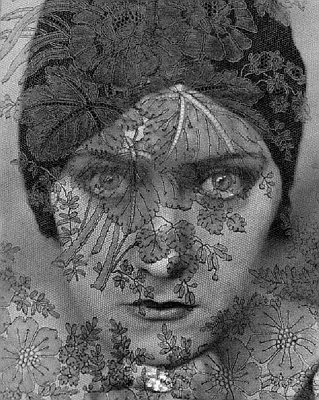
Photographers of the original Vanity Fair included Baron de Meyer and the versatile Edward Steichen, who took the enigmatic and powerful shot of a veiled Gloria Swanson (above). The revived Vanity Fair included such famed photographers as Herb Ritts and Annie Liebowitz, and during the past 25 years has continued to publish many of the iconic photographs of movie stars during that recent era.
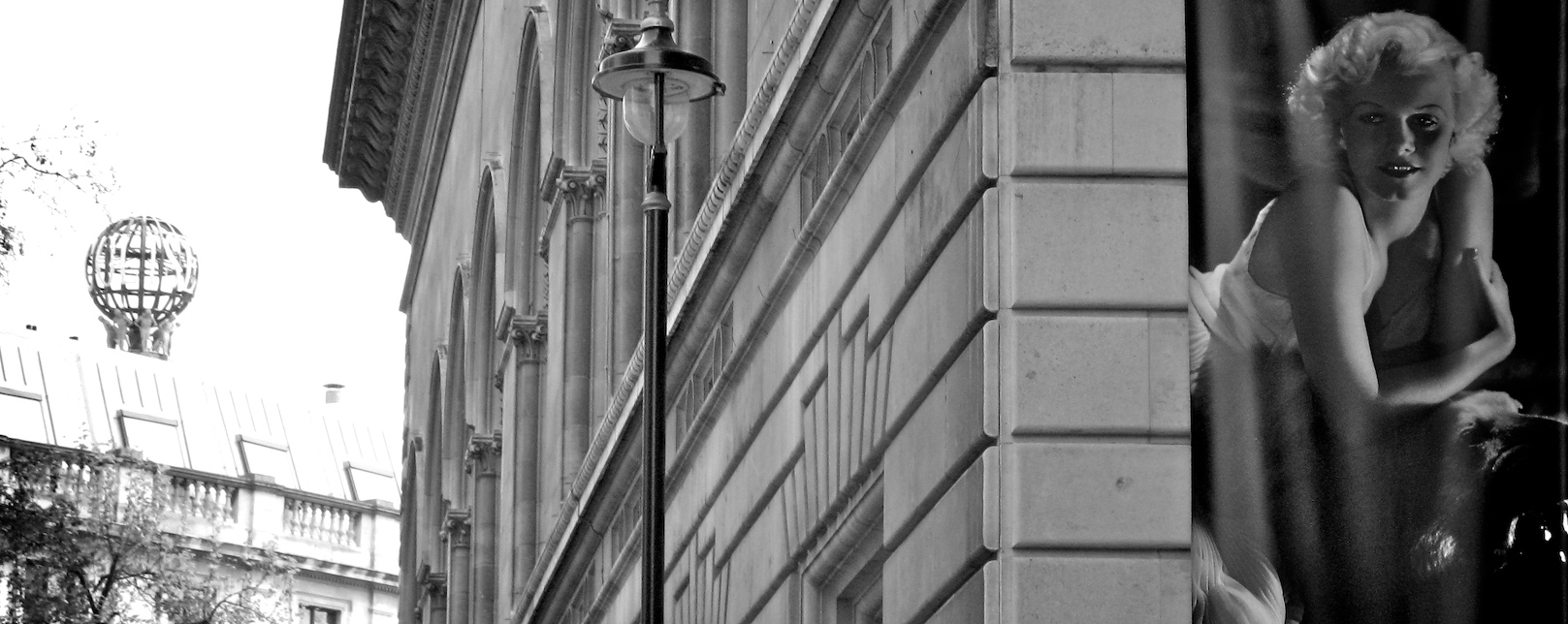
The exhibition continues until 26 May 2008 so if you happen to be in town, make sure you take a look. Below is a snap I took on exiting: Jean Harlow looking over London.
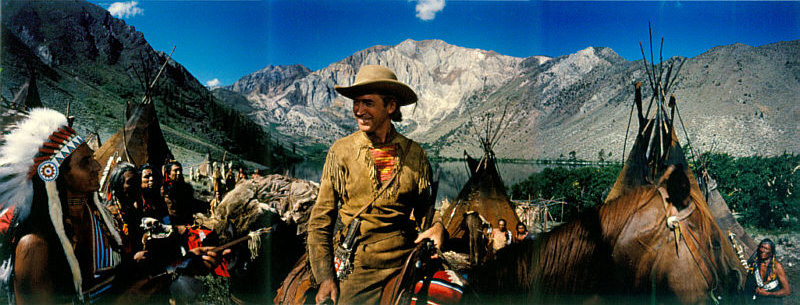
Although Cinemascope was the first of the new widescreen processes to hit the screen with the high-profile The Robe in 1953, a rival technology called Cinerama was premiered in September 1952. By using three adjacent 35mm cameras, an extremely wide image could be created. It actually required five projectionists operating three projectors to view these films. Uniquely the image was projected onto large screens that was literally curved. This would provide the viewers with a spectacular, almost three dimensional, image.

Outside of exotic travelogues intended to exploit the Cinerama experience (much like many IMAX films today), only two fiction films were shot in genuine Cinerama: How the West Was Won (1962) and The Wonderful World of The Brothers Grimm (1962). Later films such as 2001: A Space Odyssey (1968) were filmed in Super Panavision 70 and then presented in a 70mm Cinerama image rather than the 3-Strip image of the original films.
Well now you can view this fascinating process from the comfort of your own home. How the West Was Won, starring John Wayne, Henry Fonda and James Stewart (above), will be released in a new Blu-Ray edition in August. This will include a special feature known as ‘SmileBox’ which will recreate the curved Cinerama image. This seems to be a simple distortion of the image designed to create the illusion of Cinerama, as in this frame from the SmileBox website:
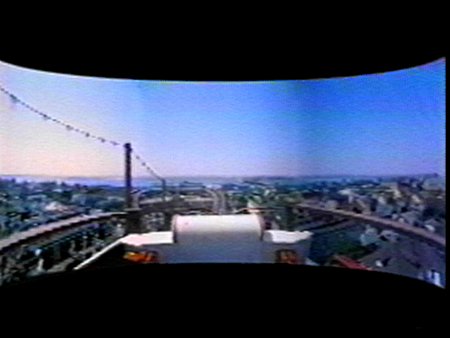
It will be interesting to see how effective this new stab at old technology is, but it sounds like an admirable attempt to present How the West Was Won as it was originally meant to be seen. Until then you can find more information on Cinerama, including some great stills of film frames, at the highly recommended Widescreen Museum.
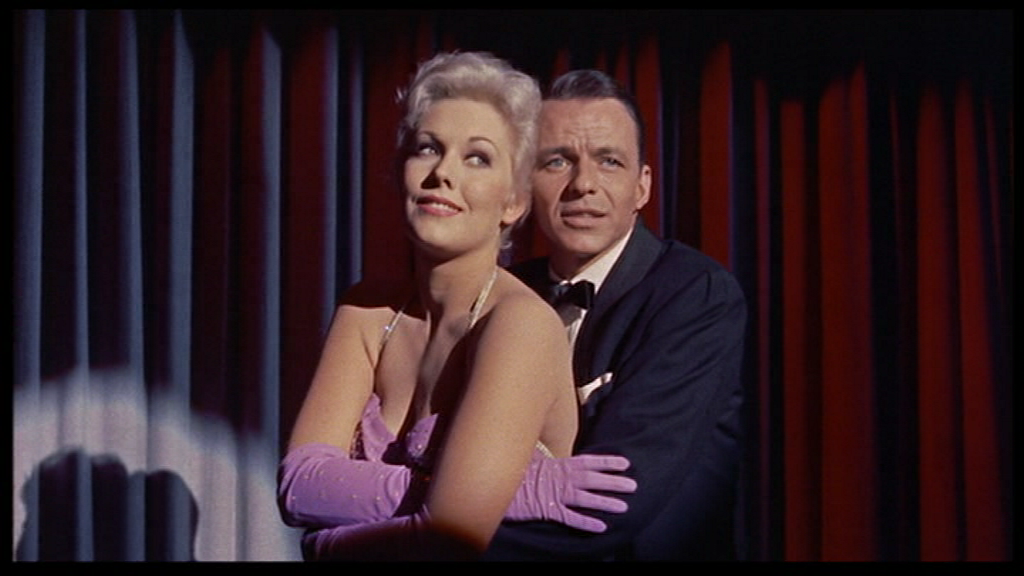
This May finds a season of films starring Frank Sinatra at the BFI Southbank in London (or as it’s really known, the NFT). Of course Sinatra has been acknowledged as perhaps the voice of the 20th Century, but he was also a fine actor, bringing the charisma and sensitivity found in his towering musical performances to the screen. While not a comprehensive season, the films on show do act as a thoughtful selection of his work.
His early roles as the skinny crooner are represented in Step Lively (1944) and Meet Danny Wilson (1951), as well as the thrilling On the Town (1949) where he starred alongside Gene Kelly as sailors on shore leave in Manhattan. From Here To Eternity (1953) was a key film Sinatra’s career. With his popularity on the wane during the early 1950s the supporting role he took in this Pearl Harbor drama earned him an Oscar and rejuvinated his career as an actor and recording artist.
Sinatra also stars in the glamorous High Society (1956) and Pal Joey (1957), an underrated adaptation of the Broadway show also starring Rita Hayworth and Kim Novak. Sinatra also starred in some particularly serious roles, such as The Man With the Golden Arm (1955) (also with Novak) and the complex The Manchurian Candidate (1962).
Two of his later films are also being screened:Tony Rome (1967) and The Detective (1968), and you even get the chance to watch a whole Sintra concert in This Is Sinatra!, a recording of a live show from The Royal Albert Hall from 1962.
But the film I’m most interested in seeing is the new print of Some Came Running (1958), which also stars the great Dean Martin in a Technicolor, Cinemascope production directed by Vincente Minnelli.
Find out more information about what’s playing at the season here.
If you have any Sinatra films that you could recommend me, please leave a comment and let me know.

Talking of Casablanca, news recently emerged that the actress Joy Page has passed away at the age of 83. She had a small but memorable role in the film as the young Bulgarian wife who pleads for Rick (Bogart) to help her. Although Rick has already made it clear that he sticks his neck out for nobody, he allows her husband to win at roulette in order to pay for the visas they so desperately need.
Page was only 17 years old when she got the part, but it no doubt helped that her mother had recently married studio head Jack L. Warner. Page went on to have small roles in a limited number of films, but also made a variety of television appearances throughout the 1950s.
She was one of the last surviving members of the Casablanca cast. It is said that the only living actress from the film is Madeleine LeBeau, who played Yvonne, the bitter young beauty who Rick forces from his Café.
Watch Joy Page in Casablanca:

Welcome to the Classic Film Show, a brand new guide to cinema ranging from around 1894-1965. It will regularly bring you news, articles, commentary, recommendations and book reviews about classical cinema. Ultimately I hope to offer new perspectives on the cinema of the past, encouraging viewers to get watching and thinking about older cinema, as well as learning more about cinema myself.
Christian Hayes.


 The Classic Film Show