la-roue-amazon

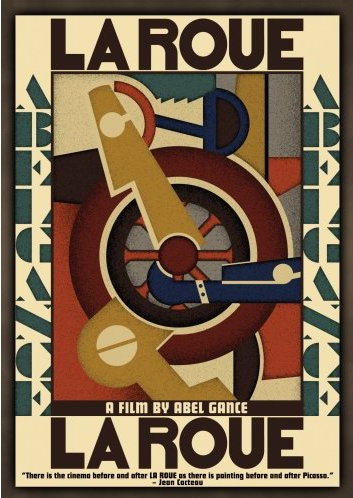
A very exciting 2-disc DVD has just been released: La Roue (1927), a monumental silent directed by Abel Gance. I saw this film on the big screen and at that time it ran at four hours, but this new restoration seems to come in even longer at four and a half. 

It revolves around a steam train engineer and the infant girl he saves from a train wreck, evolving into a complex and delicate drama. While containing some devastating and kinetic imagery, particularly around steam engines, it ultimately is one of the most memorable silent film experiences out there. Finally I get to see it again.

Directed by Abel Gance whose Napoleon (1927) is legendary, this is highly recommended. It is published by Flicker Alley, who has emerged as a great new distributor of rare silents on DVD. Check it out at their website.

Chaplin in The Circus (1928)

Let’s say someone came to you and said, ‘So, what’s the big deal with all these old movies you keep watching?’ They try to convince you they’re ‘boring’, ‘irrelevant’ and far more hard work than a quick visit to the multiplex. Some may even try to convince you that you don’t actually like them, you only think you do.

There are many ways to combat these statements (perhaps I’ll go into detail another time). For now I will suggest a few movies you should pile into their arms and send them away with (kick optional). First off:

The Circus (U.S., Charlie Chaplin, 1928)

During the 1910s Chaplin’s films gained instant popularity and propelled the British-born music hall comedian to world stardom. He became one of the most famous, popular and highly-paid men in the world, as did his famous shadow: the little tramp.

Chaplin was a virtuoso. His visceral performance style fitted the medium of film perfectly. Watching these performances, he is always busy, his face, body and hands constantly occupying themselves with an ever-shifting stream of comic business. His movement could be big – as in a chase – or they could be small – his fingertips delicately removing a cigarette from its case. Often his movements are so subtle, or so quick, that it’s easy to miss them.

One key to Chaplin’s success is the comic contradiction of the tramp. On the one hand he is a refined gentlemen with his hat, cane and delicate gestures, and on the other he is down-and-out. Somehow, from his second film (the brilliant Kid Auto Races at Venice (Keystone, 1914)) Chaplin created a universal everyman for the modern age, a character that was open to interpretation.

His performances are highly stylised, unlike even the other performers in his own films, but also in other films more widely. Unlike others his performance tapped directly into one of the primal forces of cinema: pure spectacle. So there is a pleasure simply to be had from watching the complex movement of this little man, on top of the interpretation of his performance.

One film that Chaplin did not discuss in his autobiography (My Autobiography, 1974) was The Circus (1928). The film has been long overshadowed by his other famous works such as The Kid (1921) and The Gold Rush (1924) but stands as perhaps his most purely comic feature film.

In the film the little tramp becomes involved with a circus. When auditioned, the troupe discover that he does not have the ability to be intentionally funny. Only naturally, and when not trying, is he able to get a laugh. This is tied up with a poignant subplot of unrequited love. Having fallen for the ringmaster’s daughter, the tramp’s feelings go unnoticed. 

The film is punctuated by a series of spectacular set-pieces. The opening finds him being chased by a policeman into a hall of mirrors. Later he finds himself locked into a cage with a real-life lion and finally he ends up on a tightrope being attacked by monkeys. Not only are they incredibly funny, but they are at times jaw-dropping, as when the live lion awakes to find a terrified Chaplin.

A great introduction to Chaplin, to silent cinema, and to classic film more generally, this is an underrated film that is genuinely accessible to any kind of viewer. It is also a great place to start if you’re new to watching old movies.


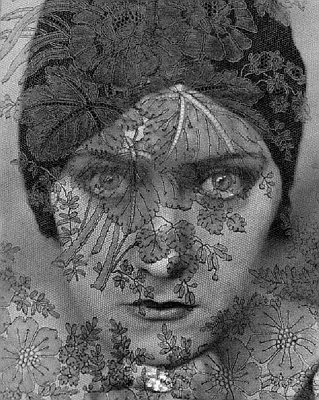
Gloria Swanson by Steichen

Today I visited the Vanity Fair Portraits exhibition at the National Portrait Gallery, a fascinating collection of photographs ranging firstly from the 1910s-30s and then from the 1980s to the present day. 

The magazine folded in 1936 only to be revived in 1983 but began remarkably early. In 1913 Condé Nast brought out the first issue of what was then known as Dress and Vanity Fair and those early issues published portraits of personalities such as a young Irving Berlin and an old Thomas Hardy.

Through to the twenties images of movie stars become a staple of the Hollywood magazine: Fred and Adele Astaire, Joan Crawford, Douglas Fairbanks, Jr., W.C. Fields, Garbo, Lillian and Dorothy Gish, Gloria Swanson, Charlie Chaplin, Fairbanks & Pickford, Gary Cooper, Cary Grant, Katherine Hepburn, Paul Robeson, Charles Laughton and Peter Lorre.

It also published portraits of writers: H.G. Wells, George Bernard Shaw, Virginia Woolf, Ernest Hemingway and James Joyce, as well as dancers, composers, scientists and high-profile directors: Nureyev & Pavlova, Stravinsky, Einstein & Eisenstein, and Ernst Lubitsch. 

Vanity Fair, then, became a great portrait of the age during which it was published. Three parts fan, fashion and Hollywood magazine it both revelled in and further circulated the image of Hollywood and its stars as perfect and ethereal.

However these photographs seem to do two things at once: on the one hand provide a stylised image of its subject, and on the other capture a candid, revealing portrait of them. The formal composition, pose and lighting creates a barrier between the image and the viewer while the connection with its subject pulls that barrier back down.

Photographers of the original Vanity Fair included Baron de Meyer and the versatile Edward Steichen, who took the enigmatic and powerful shot of a veiled Gloria Swanson (above). The revived Vanity Fair included such famed photographers as Herb Ritts and Annie Liebowitz, and during the past 25 years has continued to publish many of the iconic photographs of movie stars during that recent era.

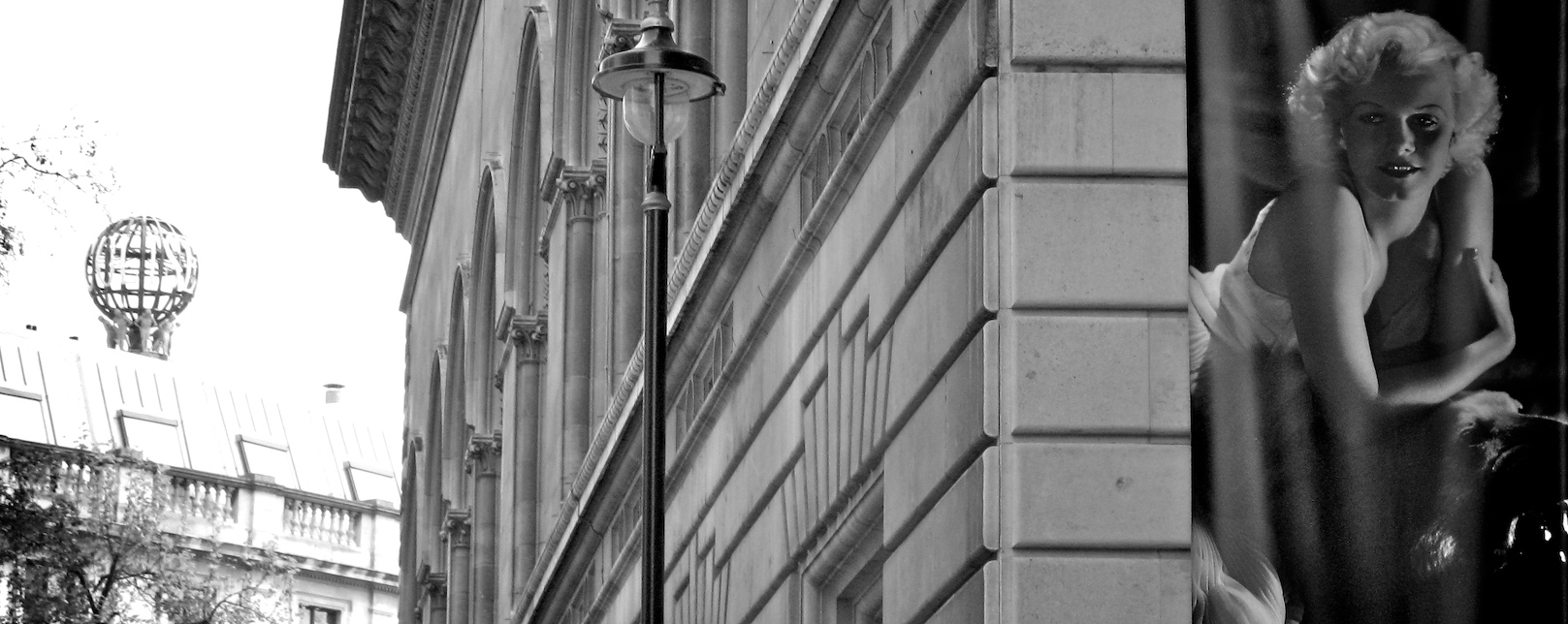
The exhibition continues until 26 May 2008 so if you happen to be in town, make sure you take a look. Below is a snap I took on exiting: Jean Harlow looking over London.

Jean Harlow in London


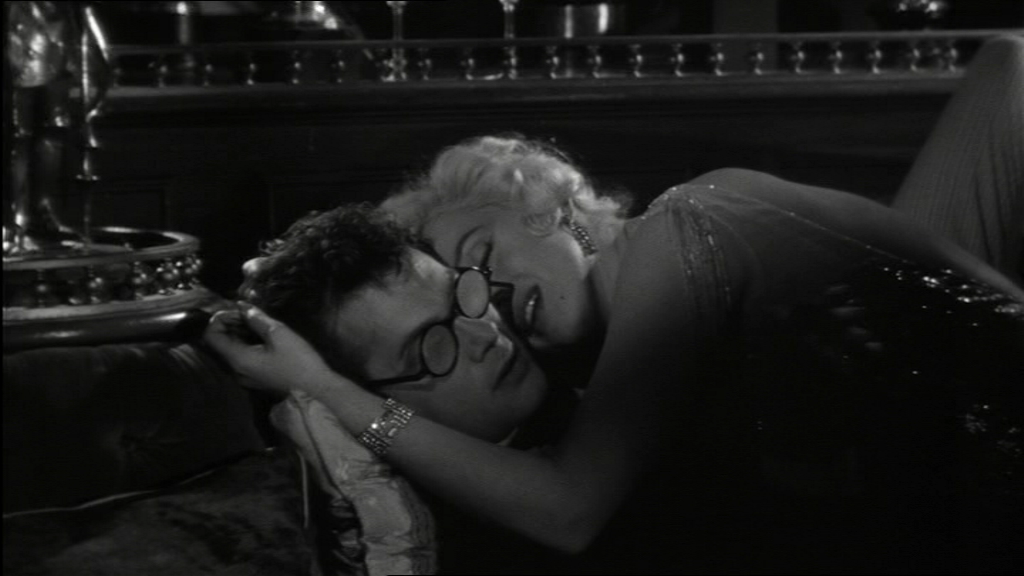
Frank Sinatra and Shelly Winters in Meet Danny Wilson (1951)

I have just returned from one of the first screenings in the Sinatra season, the little-screened 1951 film Meet Danny Wilson (USA, Universal, directed by Joseph Penvey).

In an atmospheric monochrome New York made up of bars, nightclubs, dressing rooms and back alleys, Sinatra’s hustle and swagger gives life to the city around him. He plays cocky, young nightclub singer Danny Wilson. He thinks he’s tough and likes to pick fights, except he always gets beaten. He’s backed by his kindly pianist partner and best friend Mike (Alex Nichol). Having been down-and-out since the end of the war, they are soon offered a job by a local mob boss (Raymond Burr) as long as they give him fifty percent of everything they earn.

Of course since he’s played by Sinatra, Danny has a killer voice. And fortunately he gets many chances to prove it. Singing classic songs such as, ‘That Old Black Magic’, ‘When You’re Smiling’ and ‘All Of Me’ (a particular favourite), Sinatra’s voice is at it’s absolute peak. Whenever Sinatra sings, the story, the characters and the film itself no longer seem to be important. Instead these elements are suspended as we become involved in the pure act of watching Sinatra’s face and listening to his voice: the whole experience becomes solely about him.

The images in this film of Sinatra performing on stage are archetypal of how we have come to know him in this period. Sinatra stands in the spotlight, a grill microphone in front of him, his body taking on postures that have become familiar: a slight arching of his back and cocking of his neck as the delivery of his voice requires. At this stage Sinatra was still very skinny, with his skeletal facial features clearly on show.

One sublime moment finds a depressed and drunk Sinatra in an empty bar room, head down on the bar. A girl, not knowing he’s there, puts a coin in the jukebox, only for it to begin to play Danny’s own recording: ‘When You’re Smiling’.

The plot follows the lead of Sinatra’s own career: a pop sensation followed by a Hollywood career, and is partly interesting for that clear parallel. (Indeed this was the format taken on by many a rock movie. Elvis would take an identical path in Jailhouse Rock.) One scene finds the popular Danny on-stage, the victim of a crowd of screaming and hysterical girls. Recalling the reception of Elvis later that decade, this scene debunks the persistent myth that the teenager (especially the screaming female fanatic kind) was ‘invented’ the day Elvis walked out on stage.

The twist in this movie is that the girl Sinatra is in love with (played by Shelly Winters) does not actually love him back, as would be the case in any other film. She is actually in love with his modest best friend, the supporting player.

It is set in the urban world that was exploited by noir movies, but here the city spaces are not filled with an excess of shadow. But like in noir city movies Burr’s calmly chilling mob character lends the film a lingering threat of violence. The film itself sparkled in a black-and-white print that was full of clarity and depth. 

The film is also peppered with references to Hollywood contemporaries: Jeff Chandler, Dean Martin and Jerry Lewis, and a brief one-shot, one-line cameo from Tony Curtis (who only the week before I had seen live at that very screen).

One of the first things you learn from watching and studying many films of the past is that the history of film is not set in stone. In many ways people believe that all the greatest films have been discovered and that the book is closed, but I am constantly surprised by those films considered as inbetweeners. There is so much of interest in this film that it could just as well be as revered along with other ‘classic’ films of its day.

The compositions, the performances, the tone and the sharp, punchy story really do rival any other similar films of the period. What this means is: forget everything you know and make up your own mind. There is so much to interest, entertain and enlighten you in hundreds of movies they just never tell you about.

Marilyn Monroe kisses Tony Curtis in Some Like It Hot (1958)

Some Like It Hot (1959)

On the 23rd of April I attended a screening of Some Like It Hot. The film was as funny and sharp as I remembered it, perfectly paced and performed amidst its rich narrative, effortlessly shifting from authentic gangster picture to masterful comedy.

On this occasion all eyes were on the performance of Tony Curtis, and the closer you watched him – particularly his Cary Grant impression as a millionaire oil tycoon – the more convinced you became of his skillful comic timing. In essence he played it straight against Jack Lemmon’s more explicitly comic performance (broad gestures and faces). Indeed, Curtis hardly smiles throughout the whole film.

The atmosphere of the gangster opening is so convincing that if it had continued as a gangster movie I’m sure it would have ended up as a classic of the genre. Of course director Billy Wilder dominated such a variety of genres with films such as The Lost Weekend (1945), Double Indemnity (1944) and Sunset Boulevard (1950), and he could have clearly made a killer gangster film if he had wanted to.

He certainly had a love for the gangster films of the 30s, as is evident in the knowing casting of Pat O’Brian as the police chief – who had starred alongside Cagney in 1930s films such as Angels With Dirty Faces (1938) – and also George Raft as the mob boss Spats, an actor made famous by one of the templates of the genre, Scarface (1932). In that film Raft famously flipped a coin menacingly; in Some Like It Hot he comes across a young guy in the hotel lobby flipping a coin and he asks, ‘Where did you learn that cheap trick?’

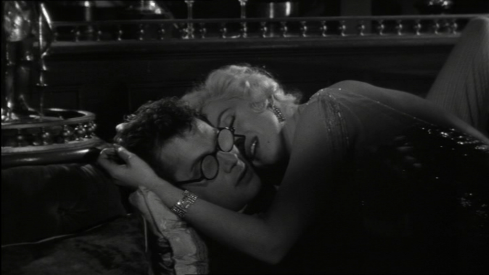
The chemistry between Lemmon and Curtis is so natural, and Marilyn sparkles. She had an acute understanding of how to use her face, body and voice to induce a sex appeal that seductively permeated through the screen; men certainly connected with it. And no more than in this film in which she drapes herself over Tony Curtis’s duplicitous character, kissing him with a soft and delicate passion, and is found on stage singing ‘I Want To Be Loved By You’, punctuating her lines with an enticing vocal shrill.

Tony Curtis On Stage

After the movie ended there was excitement. We were offered two scenes from other films, one from The Defiant Ones (1958) and the other from The Sweet Smell of Success (1957) (bottom). The crowd stirred, talked loudly, and when it was announced that the evening’s guest was on the way the audience held their breath. He was emerging from the door by the stage when the spotlight hit him and the room erupted instantly into applause that quickly transformed into a standing ovation.

It is certainly a unique experience watching a young man on-screen, as vivid and alive as if he were in the room, and then to be confronted by the very same man, now older, and in that same room. For a moment it was difficult to connect the two images of Tony Curtis. One was boyish, handsome, with his trademark thick black hair; the other was an old man who moved slowly, who no longer had any.

But it was the moment he began to speak that the two images came together. He was a very articulate speaker who was also fresh, funny and enthusiastic, and he did not need a cue from the interviewer to speak. He was more than happy to reminisce freely about the movie stars he worked with, and about his memories and experiences, all in his famous husky New York accent.

Marilyn

He talked a lot about Marilyn Monroe, about how he knew her around 1950 and was her lover for three years. He recalled how he picked her up and drove her through Hollywood in his open-top car, adjusting the rear-view mirror so that he could see the red-haired Marilyn in the backseat. They were essentially each other’s first love, and he talked of the thrill of discovering women for the first time through Marilyn. A love affair with Marilyn Monroe is now an almost abstract concept, but it was a very real one for Tony Curtis. 

He described the first time he and Marilyn spent the night together. He had taken her to a friend’s beach-side house where the waves were constantly lapping and he cooked her steak on the outdoor grill. She didn’t say a word about the sand on her steak, and neither did he. He paused the flow of his story, almost sidetracked by a far more powerful and succinct thought. All he said was, ‘I loved making love to Marilyn.’ This received a round of applause from an audience who almost did not know how to comprehend such a blunt yet powerful statement. The applause was triggered by the thrill of hearing that line coming from someone who could say it and mean it, but it soon transformed into a kind of congratulations on the audience’s part, as if to say, ‘Well done.’
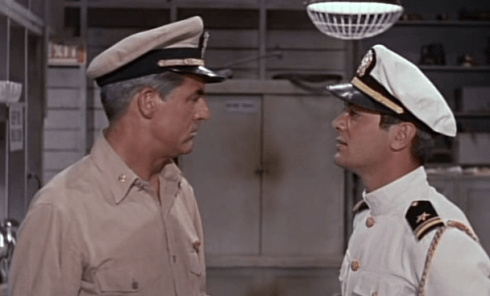
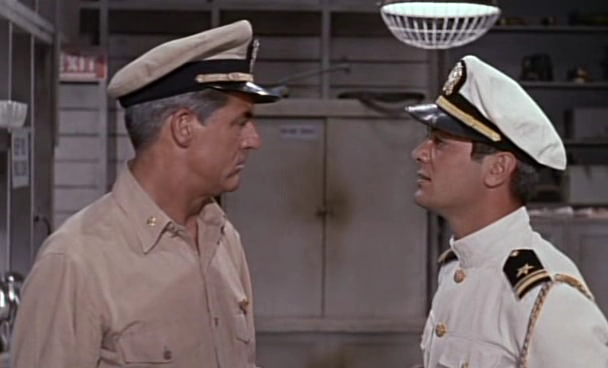
Tony Curtis and Cary Grant in Operation Petticoat (1959)

Burt Lancaster, Kirk Douglas and Cary Grant

He was asked about his mentors and contemporaries Burt Lancaster and Kirk Douglas. He spoke affectionately of Lancaster and how he brought his powerful real-life personality to his on-screen roles. He was asked about Douglas, but also how it was to work with Stanley Kubrick. ‘Kirk Douglas is tough,’ said Curtis, ‘but Stanley Kubrick was tougher.’ He really meant it when he told us that Kubrick really made them work hard on Spartacus (1960).

Cary Grant was his idol. He had watched his movies as a young man and observed the way he moved and spoke, how he handled props and especially how he handed women. In later life Curtis had the chance of working with him and he was very aware of the circle that his life had taken around Cary Grant. At 16 he had headed into war on a submarine. He said he did so because of Destination Tokyo (1943), the Cary Grant submarine movie. He used to sit on the submarine and imagine Cary Grant coming around the corner. Then when time went by and he ended up in the submarine movie Operation Petticoat (1959) (below) Cary Grant actually did come around the corner. 

Cary Grant was very supportive of him when he began in movies; Curtis took down a poster of Cary Grant off the wall outside a cinema and took it to Cary Grant to sign. In recalling the supportive message that Grant wrote for him Curtis was clearly moved, having to pause his story for a brief moment.

It was entirely Curtis’s idea to imitate Cary Grant in Some Like It Hot, and it was only something that they began working with very close to shooting, if not on the set itself. Curtis was happy to repeat his Cary Grant impression for the audience, who were naturally thrilled. When Billy Wilder screened the film for Cary Grant his verdict was: ‘No-body-talks-like-that!’

Elvis and Sinatra

Curtis was asked about Elvis, who had modeled his famous hairstyle on Curtis’s. He recalled how when walking through the studio lot one day Elvis suddenly pulled him into his trailer. The ‘boy’ talked excitedly:

Elvis: I just want you to know how much of a fan I am of yours, Mr. Curtis.
Tony: Don’t call me Mr. Curtis.
Elvis: What should I call you, then?
Tony: Just Tony.’ (pause) What should I call you?
Elvis: Mr. Presley.

It sounded like they were good friends and that they enjoyed each other’s company. Curtis added that they would ‘share’ girls, though did not clarify what this actually meant.

Curtis revealed that Frank Sinatra had the greatest music system money could buy – ‘Well he should, he’s Frank Sinatra’, he added, and that music would play all day at Sinatra’s place. Except it was Sinatra’s own records that would play. Even when with a woman he would continue to play his own music. Curtis relayed how Sinatra then once asked a lover, ‘So, how was it?’ She replied: ‘Well, the music was good.’

Universal, leading ladies, and some very good advice

Curtis painted a really vivid portrait of how it was to work during the 50s in Hollywood, mentioning an early role as a bellboy on a Barbara Stanwyck movie. Although it was a one-scene, one-line role, the director gave him advice that would stick with him throughout his career. Talking of the bellboy character who was to hand Barbara Stanwyck a letter, the director confided: ‘All you want is a tip.’ When Curtis entered the hotel room he had all the motivation he needed to give a really authentic performance.

Curtis revealed something that was very interesting to me: Universal was inferior to the other studios, and was perceived so by the industry and by those actually working in Universal pictures. They did not have a powerful head like the other studios and they produced movies cheaply for a quick profit. Generally we do not see movies as the product of studios, nor do we categorise them by studio. But studios are probably more of a defining factor of a film’s look, feel and story than we think.

It was revealed that Curtis’s favourite film as a child was The Adventures of Robin Hood (1938) with Errol Flynn. When asked who his favourite leading ladies were he named Janet Leigh right away (which received a round of applause); of course Curtis was once married to Leigh. 

He also mentioned Natalie Wood who he worked with on The Great Race (1965), a film in which he was re-teamed with Jack Lemmon. This turned about to be his favourite performance of all. He particularly loved the fencing sequence in which he swordfights with his shirt off, as well as the pie-throwing scene in which he did not get a single pie on his perfect white suit during filming (because of this they had to recreate the set and reshoot him being splattered individually).

He also gave us some really great advice: ‘don’t believe the stories you hear about the movies, make up your own minds’. Curtis told us how so much that has been written on Hollywood has been made up by writers and journalists. And he must know from experience and from what he has read about himself and his contemporaries. This is important advice for us all: question who is writing, for what purpose, and keep a critical mind, particularly with film history and criticism.

Tony Curtis was full of life. During the evening he had clearly loved making the audience laugh and effortlessly played off the rapport he had created with the audience. Funny, charismatic and very appreciative of the audience, it took him a while to leave due to the incredible power of the applause during the final standing ovation.
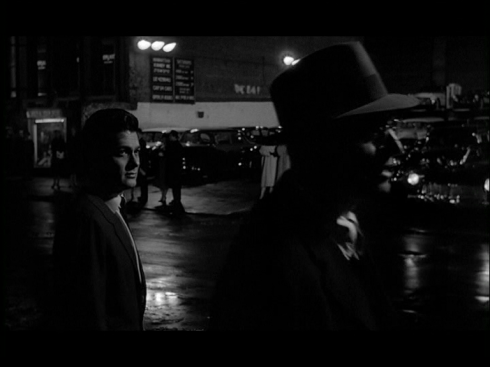
Tony Curtis and Burt Lancaster in Sweet Smell of Success (1957)

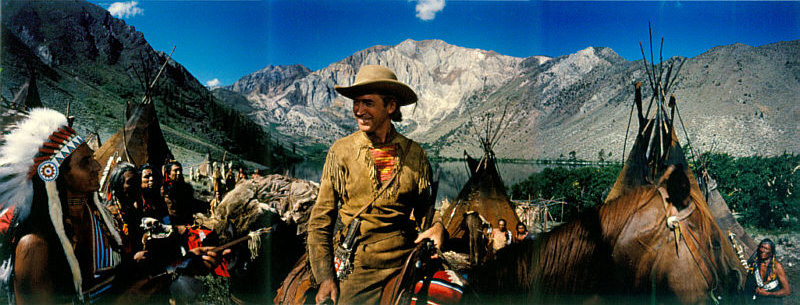
How the West Was Won (1962)

Although Cinemascope was the first of the new widescreen processes to hit the screen with the high-profile The Robe in 1953, a rival technology called Cinerama was premiered in September 1952. By using three adjacent 35mm cameras, an extremely wide image could be created. It actually required five projectionists operating three projectors to view these films. Uniquely the image was projected onto large screens that was literally curved. This would provide the viewers with a spectacular, almost three dimensional, image.

How Cinerama Is Projected

Outside of exotic travelogues intended to exploit the Cinerama experience (much like many IMAX films today), only two fiction films were shot in genuine Cinerama: How the West Was Won (1962) and The Wonderful World of The Brothers Grimm (1962). Later films such as 2001: A Space Odyssey (1968) were filmed in Super Panavision 70 and then presented in a 70mm Cinerama image rather than the 3-Strip image of the original films.

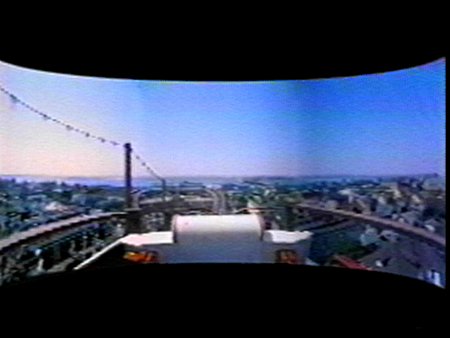
Well now you can view this fascinating process from the comfort of your own home. How the West Was Won, starring John Wayne, Henry Fonda and James Stewart (above), will be released in a new Blu-Ray edition in August. This will include a special feature known as ‘SmileBox’ which will recreate the curved Cinerama image. This seems to be a simple distortion of the image designed to create the illusion of Cinerama, as in this frame from the SmileBox website:

SmileBox

It will be interesting to see how effective this new stab at old technology is, but it sounds like an admirable attempt to present How the West Was Won as it was originally meant to be seen. Until then you can find more information on Cinerama, including some great stills of film frames, at the highly recommended Widescreen Museum.

Scottie and Madeleine embrace for the last time in Vertigo (1958)

Below I reprint the review of Vertigo published in the influential British journal Sight and Sound upon its original release in 1958, but first a brief introduction.

Hitchcock in the 1950s

I am very interested in how the reception of films change over time, and how their initial reception relates to their standing today. One of the single most interesting cases is Vertigo (1958), a film that has become embedded in the consciousness of serious filmgoers.

By the time the film was released in 1958 (1959 in Britain) Hitchcock was the most high-profile Hollywood director of them all. No doubt this was galvanised by his appearance on television as host of Alfred Hitchcock Presents (1955-61) in which Hitchcock was cleverly cementing a clearly-defined screen persona – the slow drawl, the black suit, the sense of humour, the portly figure, and the famous profile. It was Hitchcock himself who had transformed his profile into a neat logo, which then went on to open every episode of his TV show. Hitchcock had become an unlikely but powerful brand.

The 1950s saw key changes in how films were written about. Influenced by the politique des auteurs promoted by the French critics of Cahiers du Cinéma, British film critics of Sight and Sound focused more on the role of the director and the director’s responsibility for the film as a whole, then they ever had before. The combination of this shift in film criticism and the strong Hitchcock brand meant that Hitchcock’s role as an auteur was indisputable. In the review below Houston talks of a ‘typical Hitchcock joke’, for instance. Indeed Hitchcock is seen as perhaps the ultimate auteur: the precise visual style of his films suggest to the viewer that he knew what he wanted and achieved it. The controlled movement and pacing of his visuals suggest control behind the camera.

So when Vertigo was released it was clearly seen as another ‘Hitchcock film’. At first glance his films of the 1950s were clearly Hollywood products, as was the case with the glossy star vehicle The Man Who Knew Too Much (1956) with James Stewart and Doris Day, or To Catch a Thief (1955) with Cary Grant and Grace Kelly. He made a couple of grittier movies in the 1950s, notably I Confess (1953) and The Wrong Man (1956), which had the feel of film noir and neo-realism, but Vertigo was clearly aligned with his bigger releases: vivid colour, Vistavision, and a star name in James Stewart. But again Hitchcock seems to smuggle dark themes into these studio movies, with Vertigo being a particularly bleak emotional journey concerned with loss and obsession.

Today the film is revered by critics and film lovers, and during the last Sight & Sound Top Ten Poll in 2002 the film almost beat Citizen Kane to the number one spot – it was only 6 votes away. The fact that Vertigo, along with Rope (1948), Rear Window (1954), The Trouble with Harry (1955), and The Man Who Knew Too Much (1956) were quickly removed from circulation only to be seen again in the 1980s may have contributed to their appeal when re-evaluated (pirate black and white copies circulated for those desperate to see them during that dark age).

Below is the full review that was published in the Spring 1959 issue of Sight and Sound, written by Penelope Houston, which offers an interesting perspective on how the film was received on initial release. She believes that the film suffers from a plot of ‘egg-shell thinness’ and that one of its key problems is that of pacing: ‘this time he is repeating himself in slow motion’. She does not seem to have sensed the repressed passion that drives as an undercurrent throughout the film. This may be due to the fact that Vertigo is ultimately defined by its repeated viewing. The first viewing is only an introduction, but it is in the re-watching that the film starts to take hold and become an obsession.

Please let me know your thoughts on the review and leave a comment.

Scottie Dashes Up the Tower in Vertigo (1958)

Penelope Houston, ‘Vertigo’, Sight and Sound, Spring 1959, p.319.

VERTIGO (Paramount) finds Hitchcock toying weightily with a thriller by Pierre Boileau and Thomas Narcejac, authors of Les Diaboliques. As with their earlier novel, the mystery is a question not of who done it but of whether it was really done at all–in this case, how can a girl who has fallen spectacularly to her death from a church tower reappear a few months later in the streets of San Francisco, and is she in fact the same girl? This question of identity, central to the novel, is disposed of by Hitchcock in a brisk and curiously timed flashback, leaving only the secondary problem of how the hero, a detective who first trails the girl, then becomes obsessed by his memories of her, will react to discovering the truth. But in a story of this kind, a sleigh-of-hand affair built on deception and misdirection, mystification counts for everything; to introduce questions of motivation, to suggest that the people involved in this murder game are real, is to risk cracking a plot structure of egg-shell thinness. Only speed, finally, could sustain the illusion that the plot hangs together–and Hitchcock has never made a thriller more stately and deliberate in technique.

If the plot fails to work, there are still some good suspense diversion. These include a macabre, misogynistic sequence in which the obsessed detective (James Stewart) enlists dressmakers and hairdressers to make over the lightly disguised Kim Novak number two in the image of the lost Kim Novak number one; a typical Hitchcock joke, in which the detective tracks the girl down an alley, through a dark and dingy passage-way, and finds that this sinister approach is the back door to an expensive flower shop; and a single shot of stunning virtuosity, with a corpse spread-eagled across a church roof at one side of the screen, and the detective slinking out of the church door at the screen’s opposite edge. A roof-top chase, decisively opening the picture, a struggle in the church belfry, some backchat in the manner of Rear Window with a cool, astringent second-string heroine (Barbara Bel Geddes) are all reminiscent of things Hitchcock has done before, and generally done with more verve. One is agreeably used to Hitchcock repeating his effects, but this time he is repeating himself in slow motion.–PENELOPE HOUSTON

Scottie looks down from the tower in Vertigo (1958)

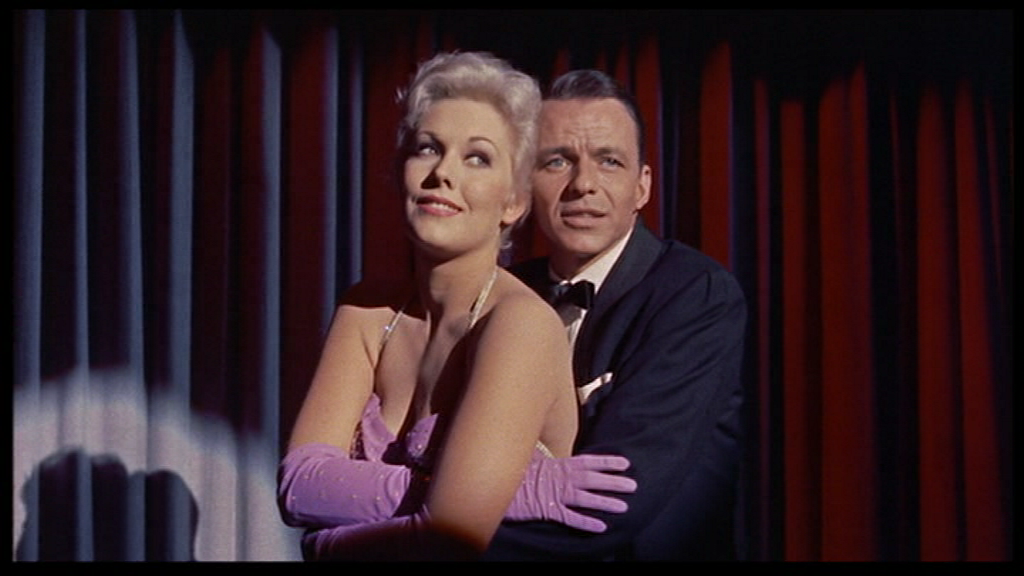
Frank Sinatra squeezes Kim Novak as he sings on stage in this frame from Pal Joey (1957)

This May finds a season of films starring Frank Sinatra at the BFI Southbank in London (or as it’s really known, the NFT). Of course Sinatra has been acknowledged as perhaps the voice of the 20th Century, but he was also a fine actor, bringing the charisma and sensitivity found in his towering musical performances to the screen. While not a comprehensive season, the films on show do act as a thoughtful selection of his work.

His early roles as the skinny crooner are represented in Step Lively (1944) and Meet Danny Wilson (1951), as well as the thrilling On the Town (1949) where he starred alongside Gene Kelly as sailors on shore leave in Manhattan. From Here To Eternity (1953) was a key film Sinatra’s career. With his popularity on the wane during the early 1950s the supporting role he took in this Pearl Harbor drama earned him an Oscar and rejuvinated his career as an actor and recording artist.

Sinatra also stars in the glamorous High Society (1956) and Pal Joey (1957), an underrated adaptation of the Broadway show also starring Rita Hayworth and Kim Novak. Sinatra also starred in some particularly serious roles, such as The Man With the Golden Arm (1955) (also with Novak) and the complex The Manchurian Candidate (1962).

Two of his later films are also being screened:Tony Rome (1967) and The Detective (1968), and you even get the chance to watch a whole Sintra concert in This Is Sinatra!, a recording of a live show from The Royal Albert Hall from 1962.

But the film I’m most interested in seeing is the new print of Some Came Running (1958), which also stars the great Dean Martin in a Technicolor, Cinemascope production directed by Vincente Minnelli.

Find out more information about what’s playing at the season here.

If you have any Sinatra films that you could recommend me, please leave a comment and let me know.

Joy Page in Casablanca

Talking of Casablanca, news recently emerged that the actress Joy Page has passed away at the age of 83. She had a small but memorable role in the film as the young Bulgarian wife who pleads for Rick (Bogart) to help her. Although Rick has already made it clear that he sticks his neck out for nobody, he allows her husband to win at roulette in order to pay for the visas they so desperately need.

Page was only 17 years old when she got the part, but it no doubt helped that her mother had recently married studio head Jack L. Warner. Page went on to have small roles in a limited number of films, but also made a variety of television appearances throughout the 1950s.

She was one of the last surviving members of the Casablanca cast. It is said that the only living actress from the film is Madeleine LeBeau, who played Yvonne, the bitter young beauty who Rick forces from his Café.

Watch Joy Page in Casablanca:

Rick is Introduced in Casablanca (1942)

Last weekend The Times offered us their version of the 100 Films of All-Time. While it may have outraged certain readers it also brought up the question of how useful these lists are, and whether they’re helpful or destructive for the reputation of certain films.

As their chief critic James Christopher’s introduction emphasised, the Times critics did not want to ‘rearrange the furniture as other lists do’.[1] Instead they have come up with, as Christopher describes it, a ‘far fresher and younger’ list. In other words they are not afraid to throw out established classics in exchange for very recent films. Christopher proudly boasts about their omission of Citizen Kane. Rather than being a refreshing and bold move, this comes across more as a shallow trick to bluntly signify how this list differs from all others.

Christopher’s reason for this omission is that Touch of Evil has ‘greater resonance than Kane’. But what is he actually saying here? One of the frustrating things about film journalism (the public’s primary source of film writing) are statements that are never clarified. What kind of resonance is he talking about here? The sad part is that many young viewers have real difficulty watching Kane in light of its reputation, and many look for any excuse to either not watch it or deal with what they’ve seen (see it’s imdb page), and this list gives them another excuse to fight it. (For information on how Kane received its reputation see my own post here.)

Here is the Top 10:

10. The Godfather
9. Eternal Sunshine of the Spotless Mind
8. Sunset Blvd.
7. Kes
6. Vertigo
5. The Shining
4. Chinatown
3. ET: The Extra Terrestrial
2. There Will Be Blood
1. Casablanca

The list’s other obvious trick is to include very recent movies, including Lost in Translation, Eternal Sunshine of the Spotless Mind and There Will Be Blood in the number 2 spot. There Will Be Blood was only released in this country earlier this year and its inclusion is purely intended to fire debate. But since the film was received with unanimously favourable reviews, it’s also a pretty safe bet amongst filmgoers. [2]

So what are these lists for? Christopher states that the point is to ‘stimulate argument’, and so these omissions and submissions are clearly there to provoke reactions from outraged readers. A quick look at the list’s online message board finds a whole list of favourite movies and established classics being waved about in light of their omission: The Third Man, Shane, Lawrence of Arabia (I am not surprised to find no mention of Chaplin in the list). Many have also pointed out that Lee Van Cleef did not play Liberty Valance.

On the one hand these lists could be helpful to viewers as a shorthand as to what to watch next, and indeed many a great discovery could be made by working through 100-lists. But lists are also interesting for what they say about the popularity of certain films, and how film history is considered at that particular moment. The earliest film on this list is Metropolis (1927) which stands alone in representing the entire silent cinema (wouldn’t it be great to see some 1910s movies make one of these lists?). The only films from the 1930s are Duck Soup (1933), The Wizard of Oz (1939) and Gone With the Wind (1939). Films like Metropolis and Duck Soup have come to represent large periods of film history and discerning film viewers know that these periods are rich with many equal titles. In many ways I would choose another film directed by Fritz Lang over Metropolis, perhaps Spione (1928), if only because with its exciting spy narrative would be far more accessible to casual viewers than the complex and brooding Metropolis.

So in many ways these lists fail to promote classic cinema. While it omits Citizen Kane so as to appear forward-thinking, it repeats Metropolis (arguably the most famous silent film) and fails to probe into the earlier decades of cinema. These singular titles are journalistic shorthand for certain decades, and serve to reaffirm a version of film history that goes uncontested.

But then at the top spot sits Casablanca, a film that perhaps represents the ‘classic’ cinema more than any other. Many readers will probably be unimpressed by this conclusion, and it almost seems to counteract Christopher’s insistence of the list’s fresh outlook. At first glance its selection would actually seem to be a far bolder statement than the omission of Citizen Kane: that established, classically-styled Hollywood cinema ultimately trumps films that appear far more radical. But then a glimpse at Christopher’s copy that accompanies this entry ultimately seems to undermine this statement:

Casablanca is the greatest romantic thriller yet painted on screen. No one could accuse Curtiz of minting high art, but does that honestly matter?
Casablanca is shameless entertainment. [3]

Precious space for insightful film criticism is often wasted on hyperbole. In this case it is a statement of fact that the film is ‘the greatest romantic thriller’ of all time, though ultimately how helpful is that statement? It serves to ephasise the film as standing alone (a point which I’ll come to in a moment) and ultimately is unhelpful to an understanding of Casablanca. Of course it is also a wild opinion that I would argue, on the evidence of the list itself, does not actually take many other films into consideration. I perhaps shouldn’t even point out that films are not actually painted at all (yes, even with light).

But here Christopher seems to be defensive, apologetic and detrimental to the film itself. By emphasising Casablanca as being ‘shameless entertainment’ rather than ‘high art’, Christopher intends to proudly champion the film as a product of popular culture. But this conversely suggests that Casablanca sits outside of the realm of ‘art’. Without going into a broad debate this hints at an outmoded idea of what kinds of cinema can be construed as ‘art’, emphasised by Christopher’s pointing specifically to director Michael Curtiz: ‘No one could accuse Curtiz of minting high art’.

This phrase suggests two points: that Christopher is holding Curtiz responsible for Casablanca, and in using the word ‘Curtiz’ is actually referring to the visual style of the film. This is very common practice in contemporary film criticism and journalism. It has become an absolute reflex to refer to a director as solely responsible for the film as a whole (i.e. Curtiz’s Casablanca, Hitchcock’s Vertigo). The director’s role has also solely been reduced to that of visual style. Here Christopher is using Curtiz’s name to refer to the film’s visual style: ‘No one could accuse Curtiz of minting high art [through the film’s visual style]’.

The visual style of Casablanca is a classical one. Watching other Hollywood films of the period and you will see a similar style – establishing shots, two-shots, medium close-ups, shot/reverse-shot. The editing works stealthily and follows a clear logic (a man leaves one room, cut to the next room). Wild shots and jarring editing are rare, and this all works to make the machinations of the movie invisible to the viewer, to never remind them that they are watching a movie. Some see this as an anonymous style, and some confuse it as being uninteresting work on the director’s part. Taking this into account, Christopher is undermining the film here by suggesting that you cannot accuse Curtiz’s input (in other words the film’s visual style) of taking cues from anything as sophisticated as ‘high art’. In fact the classical Hollywood style is an incredibly sophisticated visual system, of which Casablanca is a fine example. Its visual style is particularly economic, taut and sensitive in the telling of the film’s complex story.

Lists tend to make their films appear scattered, disjointed and disconnected from each other. They are seemingly to be watched alone, in isolation, and to be judged solely on the experience of watching them today. ‘Are they still “good”? Can I relate to this in the 21st Century? How does this old film offer similar experiences to new ones?’ The one problem with this method is that we may not be equipped with the context to understand a film from the past. One of the great pleasures of watching classic cinema stems from viewing films in relation to each other. This allows the interrelated films themselves to provide part of the context required for a closer understanding of them. Perhaps a more equal list would be 100 films selected from each of 100 years, forcing a selection from eras that are usually neglected.

What do you think about Top 100 Films, and this list in particular? Do you find them useful and if so how do you use them?

Notes

[1.] James Christopher, ‘Take your seats’ in ‘The Times The Top 100 Films of All Time’, Saturday 26th April 2008, p.3.

[2.] I do find it strange when films receive either unanimously dreadful reviews as well as unanimously favourable ones; in both cases it can’t help but affect the reader’s/viewer’s perception of the film.

[3.] James Christopher, ‘Casablanca’, in ‘The Times The Top 100 Films of All Time’, Saturday 26th April 2008, p.33.

Contact Me

Christian Hayes
classicfilmshow@gmail.com
christianhayes.net
The Classic Film Show on Twitter

Add to Technorati Favorites
January 2026
M T W T F S S
 1234
567891011
12131415161718
19202122232425
262728293031  

The Classic Film Show on Flickr